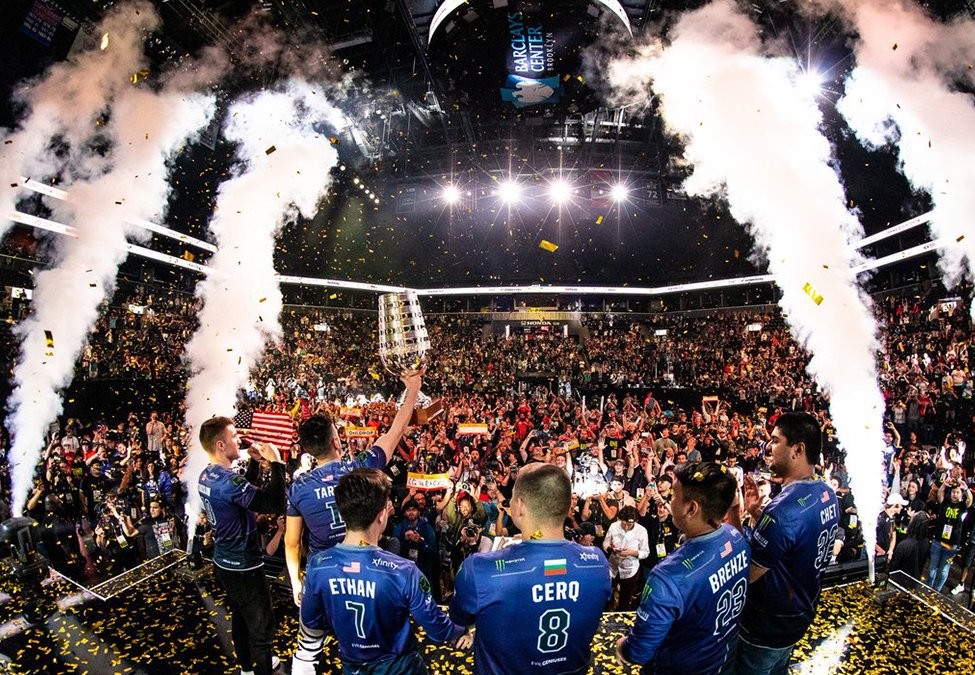
On episode 224 of the Digital and Social Media Sports Podcast, Neil chatted with Kyle Benzion, Director of Social Strategy for the Orlando Magic NBA team.
Listen to episode 224 of the Digital and Social Media Sports podcast, in which Neil chatted with Kyle Benzion, Director of Social Strategy for the Orlando Magic NBA team.
What’s the most popular professional sport in the US?
Don’t think too long and hard about it; your first thought was probably football. What if the question changed to which professional sport do the most people have experience playing? That changes the equation a bit — it might be soccer, maybe baseball, but almost certainly the video games category is the correct answer there. And yet (American) football reigns supreme. Why?
This isn’t a story about football, though, it’s about all the reasons fans become fans and the different pathways to fandom. Because there is no more accessible sport than esports — a sport that can be played at any age, just about, and by anyone. And yet esports could also be called quite inaccessible — there are so many different gaming titles within esports, with unique communities, culture, jargon, and sometimes even insularity.
But Kayci Evans and esports organization Evil Geniuses are out to ensure esports welcomes everyone with open arms and, just as importantly, gives potential fans a way to connect to the most accessible sport in the world. Esports is unique, though. Not just because the actual competition takes place beyond the physical world, but because it is a sport comprised of tons of other sports. There is only one baseball, but there are hundreds, thousands, millions of video games.
So how do you market to fans that may be familiar with video games, in general, but have little to no experience with the specific games in which your teams compete? It’s not easy, but Evil Geniuses are Evans are finding a way. And in doing so are bringing to life universal truths about culture, fandom, and connection.
“Because you already don’t know how to play the game, or whatever they’re talking about; and then on top of that, there’s a lingo that is matched to that game style or that community,” said Evans, who is the Director of Global Brand Marketing for Evil Geniuses. “So it makes it a challenge on the marketing side to figure out how you’re gonna break down the barrier to entry.”
One way Evil Geniuses (EG) has brought fans, with vastly different levels of experience and knowledge about the games, together has been through (relatively) universal cultural experiences. Evans talked about how there are countless memes that enter the mainstream (or at least as ‘mainstream’ as anything can be these days), memes that often originate in the Subreddits, Discord servers, and Twitch and Twitter chats of the esports world. And while the hyperspeed and esoteric moves of esports can be intimidating and confusing to casual fans, memes — memes are something anyone can connect with. So EG built an activation around the uber-popular ‘touch grass’ meme.
“[The touch grass meme] is probably more of a general internet meme versus a League of Legends meme or a VALORANT meme or whatever,” said Evans, who worked for Major League Baseball prior to joining Evil Geniuses. “And so [it’s] tapping into things like that where you can start to seed the language to our audience that we’re trying to reach and get them in.”
The memes and other universally relatable things can help get potential fans in the door, to capture attention, if even for a brief moment. But how do you move them up the fan spectrum, or down the marketing funnel [if you prefer]? Just like not every football fan is a fan for the same reasons, the fans in esports have different things that may augment their avidity, as well. As Evans thinks about reaching the diehard esports fans that know all the ins and outs of the games, while also engaging those casual fans that don’t know Call of Duty from League of Legends — and all the fans in-between — it’s often about finding things that can span the spectrum. Evans talked about envisioning a future of scale, and segmentation, but also a campaign that can straddle all sides.
“I’d love to get to a point where we can host a marketing campaign that is super targeted to certain audiences and [then almost] multiplied,” she said. “So we can have a version of it that’s for our APAC audience, and we can have a version of it that’s for the hardcore gamer and it’s very stat heavy or whatever it might be, and then we can have a version that is for the casual gamer who just happens to like Animal Crossing and playing [Nintendo] Switch. But maybe the tie-in there is — if they play on Switch, they also play Zelda, and if they like Zelda and the lore of Zelda and the world-building, they might like the lore of League of Legends.
“Where’s the middle and how do we really go all-in on that cross-pollination and the middle line that all of the fans we’re trying to reach can participate and don’t feel left out?”
Evans and her team are trying to find things that don’t require an esoteric knowledge of gaming or the esports communities and jargon to understand. Because those (more) widely relatable ideas, content pieces, and campaigns are a welcoming introduction to any new fan — the top of the funnel, so to speak. Not every fan’s path to fanaticism is linear, but the paths are connected. “It’s all about connecting dots and trying to think about what would get you to each phase [the fan funnel] diagram?…, Evans explained to me. “How do you get people down the narrow funnel by hitting them with something a little more vague that they can connect with?”
But what comes next? How can teams and organizations like Evil Geniuses strengthen those fan connections, forming more powerful emotional ties? Fun activations, hilarious memes, and cool gaming tips and highlights can capture interest and tickle the senses of fans, but it’s hard to conjure feelings of love and dedication with those tactics alone. Fans fall in love with human stories — because while their avatars and gameplay may be digital, there are real people competing in front of those screens, living out lifelong dreams and playing a game at the highest of levels under the utmost of pressure. It’s through those players — and their stories — that Evil Geniuses can begin to capture fans’ hearts, deepening their path down the funnel.
“Where we’re gonna start to kind of separate ourselves in terms of really focusing on the human experience,” said Evans. “And yeah, it sounds difficult, but it’s actually so simple. It’s like what we all know at our core. So I think that’s gonna be big on how we get to fans.”
All the best content, campaigns, strategies, and tactics can drive fan development in any sport, but there is nothing more powerful than parents passing it on. If kids develop their some of their biggest passions at age 9 or 10 depending on which research you see, it’s not a stretch to say that we’ll know esports has truly ‘made it’ when playing catch or shooting hoops with mom or dad meets gaming. Then you’re building fans for life.
But guess what? It’s already happening. And as organizations like Evil Geniuses develop more fans and more avid fans of all ages and cohorts, such lifelong and generational fandom will continue to flourish. Evans talked about her own epiphany when, while at a conference and, still early in her tenure with EG, she saw a parent alongside kids pulling a wagon holding their gaming setups — supporting them like any parent supporting their kids in a sport.
“It was literally like watching a kid’s tee-ball game or something,” she said, the joy evident in her voice as she recounted the story. “And here you have dad wagoning in all their PCs, he’s taking them into the venue, he’s setting up their computers. You have parents who set up their popout chairs to watch their kids play.
“I mean, it is the same. It is just, you know, not the same.”
On episode 223 of the Digital and Social Media Sports Podcast, Neil chatted with Kayci Evans, Director of Global Brand Marketing for esports organization Evil Geniuses.
Listen to episode 223 of the Digital and Social Media Sports podcast, in which Neil chatted with Kayci Evans, Director of Global Brand Marketing for esports organization Evil Geniuses.
The sports sponsorship and advertising space is evolving in multiple directions. In some ways, analytics and marketplaces and automation can make partnerships like mathematical transactions, no different than the NBA Trade Machine on ESPN.com. But then there are true partnerships — with each side banking on the other, entering into a mutually beneficial agreement with upside; the whole greater than the sum of their parts.
That sounds good on paper, but what does it look like in practice? While massive athletes and organizations can play the upper hand, the up-and-coming or niche athletes and organizations face a more level playing field. And it’s in those scenarios where the partner in partnerships is even more integral.
It is at this intersection where Andrew Stallings and Athelo Group are flourishing, with brands investing in athletes and vice-versa, both rising together. Stallings and his team work with some athletes on the rise, others that are at or near the top of their sport, even if their sport is not among those typically shown on SportsCenter every night or debated on First Take. For Stallings’s clients, it’s showing why they’re a great investment — why they’re valuable and how their value is only growing (so invest now!).
“(These athletes) need somebody to be constantly upselling, showing how I can bring more value, how this is growing, [how] that’s growing,” said Stallings, who is Founder and President of Athelo Group. “If my TikTok’s not working, my email newsletter is. If my email newsletter isn’t working, guess what? We’re starting a subscription box service in the next three months. They just want us to be constantly in that person’s ear to help build them.”
Stallings added that the athlete should show that same interest in learning about the goals, values, and opportunities of their brand partners, too. “They should learn, they should be able to understand the brand,” he said, “the company, the morals, the people that they’re working with and representing; because [then] social content, messaging, and really explaining to their own audience why they work with a brand is gonna come second to none. It’s not gonna be just hashtag ad.”
The opportunity is boundless for athletes as the creator economy builds out more avenues for activation, as Stallings alluded to above. The most appealing partners in the sports space, in any space, are offering not just ad space, but a platform; a platform built around them. The savvy athletes are dipping their toes, if not diving all the way, into a number of tributaries that can activate their brand and engage their fans — and present new avenues for partners to come along for the ride. Stallings talked about the partnership marketing piece to athlete sponsorships; while a select few superstars may have deals thrown at them like scripts to a movie star, for most of the sports world, there’s a marketing, buy-and-sell aspect.
“(Brands) want to converse with agencies and teams and athletes and influencers that have a diverse portfolio of assets for them to activate against,” explained Stallings, whose Athelo Group has formed and activated marketing partnerships with athletes and brands since 2018. “They don’t all need to be built out. You don’t need to have a million followers across every single platform you work with. You don’t need to have audiences with massive buying power.
“What you do need to show is that you’re working towards and you’re trying and you’re steadily building and finding the success to be able to provide case studies to these brands of what is working, what can work, and what can be better with their help…They’re looking at how can this individual or how can this agency bring forth more assets to complement existing campaigns, further brand’s activation ideas and stuff that we have — how can they complement and be a supplemental resource to us?”
There’s a different feel when both parties are on the same side of table. There’s a desire, and even instinct, to not plan to execute the minimum requirement combined with the least necessary effort. Instead, the sense of teamwork and genuine connection can entrust and empower each side to optimize how they put the partner’s campaign into action. There is a positive feedback loop at play — the more believable the athlete activation, the more their authenticity and appeal to fans increases, thereby adding to the athlete’s value as a partner. Pretty cool, huh? Stallings calls it the “good stuff” and goes into detail about the realistic, ideal scenario.
“(You) find the authenticity, find the pivot, and be prepared when things don’t perform the way that the brand is expecting them to, be prepared to offer up alternatives, be able to give more and more before you’re just sending over that invoice,” he said. “Because that’s the good stuff, right? Like, you might be educating them by saying ‘Hey, if this is just an Instagram campaign, I get that you want to carousel, but I’ve been seeing great value with Reels. Do you mind if, for you, on the house, I just experiment by mixing your product in on this Reels post and let’s see how it goes?’
“A lot of people won’t do that. But if you’re one of those more lesser-known creators with value and upside, take the risk. What’s it gonna do? It’s gonna be an extra hour of work for you and you know what? You might have gotten yourself three more campaigns because of it. So you have to always be willing to overdeliver a little bit.”
In order to deliver (and overdeliver) and optimize, it’s essential to understand what success means for each side. That goes back to understanding objectives and strategies, to be sure, but the KPIs presented can also expose a bit about the relationship. There are transactional, immediate and visible ‘ROI’ partnerships, and then there are those may include more long-term, penetrating partnerships that expect to last a long time. Both types, and those in between, can be seen all over, but Stallings knows the type he likes to look for for Athelo’s clients.
“For some people [ROI means] big numbers, that’s all they want. Other people they’re like, man, we want signups. We want link clicks. We want sales,” said Stallings, who worked at Octagon, among other stops, before founding Athelo. “I think the worst nightmare you can ever have when working with a brand or an agency or anybody is if they are 100% sales-driven and nothing else, [it’s] probably best for you to walk away because they are not seeing the bigger picture of the authenticity of a relationship and they probably haven’t done the homework on your audience.”
Athletes thrive when working as part of a team. They want to be versatile, multi-tool players. And they will study and adjust and do what it takes to win. That all sounds like a winning formula for their competitive endeavors and well beyond.